
Home / Our programs / Book distribution
Program 04
Notebooks, books and the confidence to open them
A child without a notebook is easily left behind. Our book distribution program puts study material into the hands of children whose families cannot buy it.
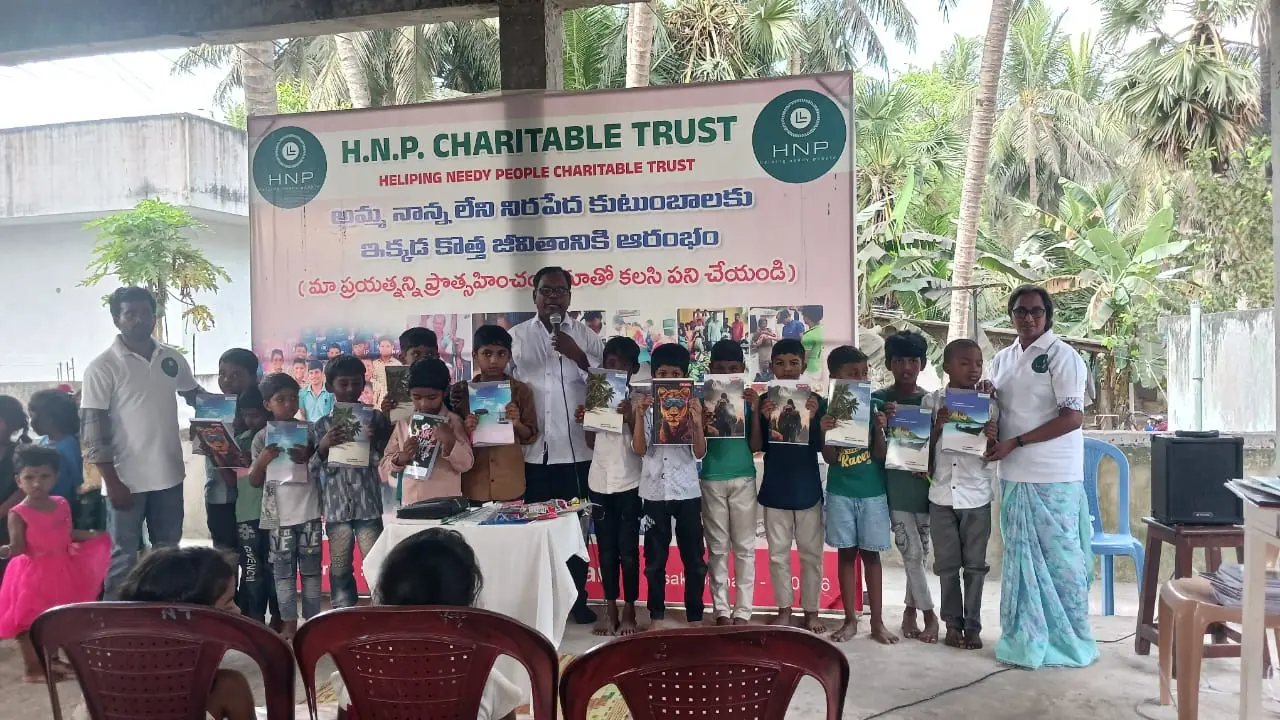

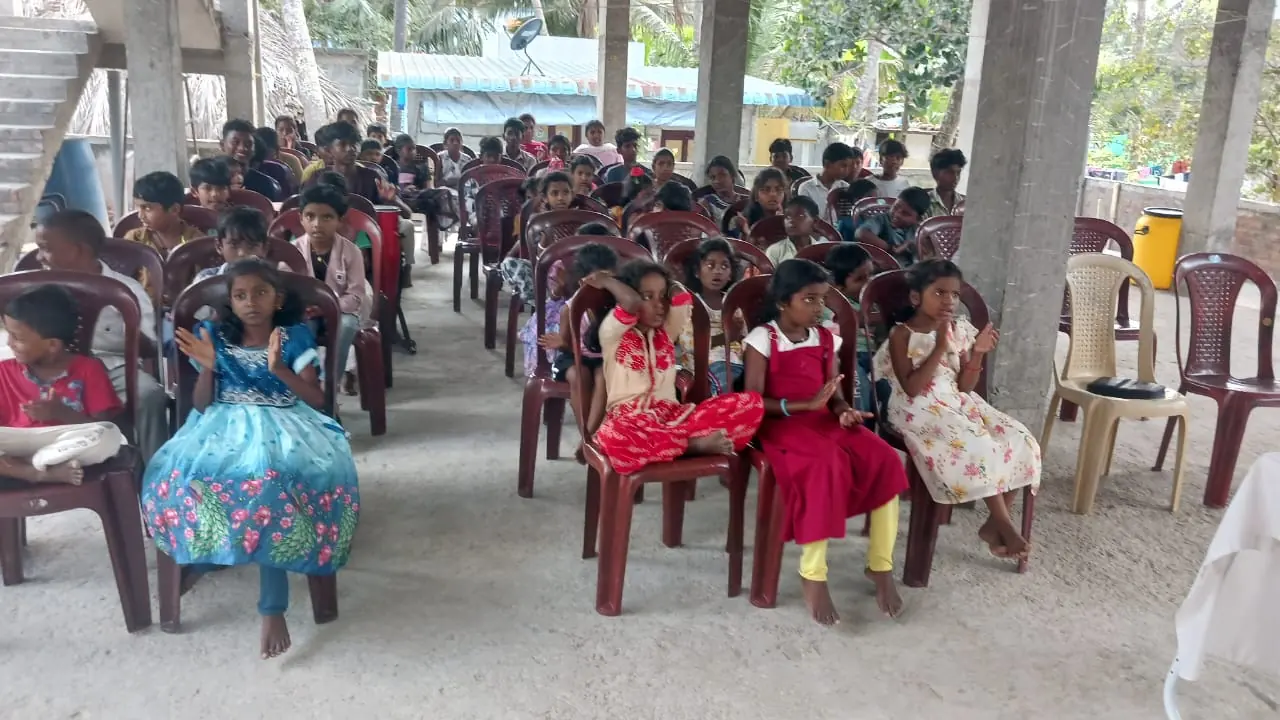
What we do
Children, a banner and a pile of books
Our photos show children standing in rows in front of an HNP Charitable Trust banner, each one holding a bag or a set of notebooks. Others show a hall full of children seated on chairs, waiting for their turn.
The annual report describes the aim of the program as promoting reading and literacy among children from disadvantaged backgrounds. It lists a wide range of subjects, from literature and science to mathematics and general knowledge, and mentions storytelling sessions that make reading enjoyable.
The report records thirty children who received books and learning material in the year, and says the trust worked with local schools and community groups to find them.
Why books are only half the answer
A free book does not help a child who is hungry or who has no place to study. That is why our book events usually come with a meal, and why we ask teachers to tell us which children are at risk of dropping out.
The report says that the program is meant to bridge the educational divide. The word divide is right. Two children in the same class can have very different homes, and the one with fewer books falls behind early and rarely catches up.
How children are chosen
We rely on teachers, community leaders and the children’s homes we visit. They know which family has lost a wage earner, which child walks to school without breakfast, and which child sits at the back because he has no uniform.
We keep a list of the children and what each one received, so that a child is not given the same thing twice and nobody is left out.
What goes into a kit
A typical kit holds notebooks, pens and pencils, a geometry box and a school bag. Where a child needs a textbook that the school does not give, we try to buy it.
Story books are part of the report’s plan, too. Reading for pleasure helps a child who finds school dull to build the habit of reading.
Teachers and tuition
Our volunteers include students and graduates who sit with children after school. Photos from our programs show children sitting on a rooftop with books while a volunteer teaches them, and rows of children at an education event in a covered hall.
If you can teach for an hour a week, we can find children who need you.
What a child needs for a school year
A child in Class 5 needs about six to eight notebooks, two or three pens and a pencil box, a school bag and a set of textbooks if the school does not supply them. A child in a higher class needs more notebooks and a geometry box. Most poor families cannot buy all of this at the start of the year.
Many children start the year with half a kit and finish it with none. A sensible plan gives each child a full kit early, and a small top-up in the middle of the year when notebooks fill.
How to support a child's reading at home
Reading at home does not need books in the house. A parent can ask a child what she read today and listen to the answer. An older child can read to a younger one. Library books, even a handful, make a difference to how a child feels about reading.
If a family has no light at night, a rechargeable lamp is a very useful gift. We ask schools to tell us which children study by candlelight.
Why attendance matters as much as books
A child who misses school for a week may not catch up. Our volunteers ask teachers about attendance, and we follow up with families when a child stops coming. Sometimes the reason is simple: no shoes, no uniform, no breakfast, or a younger brother to look after.
When we solve the small reason, the child returns. That is why our book program is connected to our food, clothes and sandal programs.
Giving books the right way
We hold an event, call each child by name and hand the kit over in person. This is not a favour from a donor to a child. It is a moment of recognition. Children come with their parents, who see that someone cares.
Please do not send random second-hand books. Old books with torn pages or out-of-date syllabus help nobody. We welcome clean, complete books that match a class.
How a teacher can refer a child
Teachers see the first signs. A child who comes without a notebook, who copies from a neighbour, who has no pen or who is always at the back of the class may need help. A teacher can write down the name, the class, the village and what the child lacks, and send the note to us by phone or through the form on this page.
We ask teachers to be discreet. A child should never be pointed out in front of classmates. We prefer to give the kit at an event for all children, so that the child receiving it does not feel marked.
When we visit a school, we thank the teacher in front of the children. Teachers are the people who keep a child in class day after day, and our books only matter because they do that work.
How it works
From a gift to a bag
Each kit follows the same four steps.
1
Find
Teachers and homes tell us which children need books.
2
Buy
Volunteers buy notebooks, pens and bags in bulk.
3
Hand over
Children come to an event and receive their kit in person.
4
Follow
We ask teachers whether attendance and marks improve.
Questions
Book program questions
We take notebooks, textbooks and storybooks in good condition.
Can I donate old textbooks?
Yes, if the pages are clean and the syllabus is still current. Call us first so that we can match books to a class.
Do you give uniforms?
We give uniforms and clothes when a child needs them, but books and notebooks are the core of this program.
How many children have you helped?
The annual report records thirty children in the reporting year. We do not add numbers that we cannot back with a list.
Can I sponsor a child for a whole year?
Call us. We will explain what a year of study material costs and let you choose.
Do you run reading sessions?
Yes. The report mentions storytelling and reading activities that make learning enjoyable.
Can a school ask for help?
Yes. Tell us the class, the number of children and the kind of material they need.
Do you give books in Telugu and English?
Yes. Children choose according to the medium of their school.
Do you give college books?
Our focus is school children. For college students, call us and we will discuss each case.
Can a company give a hundred kits?
Yes. Call us. We can plan the event and give the sponsor a photo record.
How do I know the books reached children?
We share photos from each event and keep a list of the children who received kits.
Put a book in a child's hands
A notebook costs very little. A child who has one comes to class with a plan.
Write to us
Ask about book distribution
Tell us what you would like to know or do about book distribution. A volunteer will call you back.
- +91 97036 30893 (call and PhonePe)
- +91 82972 92602 (second number)
- hnpcharitabletrust@gmail.com
- NPS Nilayam, Road No. 2, Gajuwaka S.O., Visakhapatnam, Andhra Pradesh 530026
Write to us
We use your details only to reply to this message. Read the Privacy Policy and the DPDP Act notice.