
Home / Field work / Family and disability support
Field work
A ration kit, a wheelchair and a visit from someone who cares
A family in difficulty may need many things at once: food, a wheelchair, medicine, schooling. Our volunteers visit, listen and bring what they can.



In our photographs
A new wheelchair, a trolley of groceries and a family at home
One set of photographs shows HNP volunteers and a family at their house, handing over a ration kit. Another shows a man seated in a new wheelchair, with volunteers standing behind him. A third shows a volunteer in a shop with a trolley loaded with rice and groceries.
A poster made by the trust shows a family’s kit of rice, oil and groceries, with a line of thanks. A wheelchair stands in a room with books and a guitar, waiting to be given.
These are not big gifts. For a family that has run out of rice, or a man who cannot leave his bed, they are the difference between a day and a night.
How we find families
Most families are found through neighbours, teachers, caretakers and volunteers. A neighbour tells us that a man has had an accident and cannot work. A teacher tells us that a child has stopped coming to school. A volunteer sees a family on a food service day and offers to visit.
We visit before we give. We see the home, ask about the family and decide together what will help most.
Ration kits
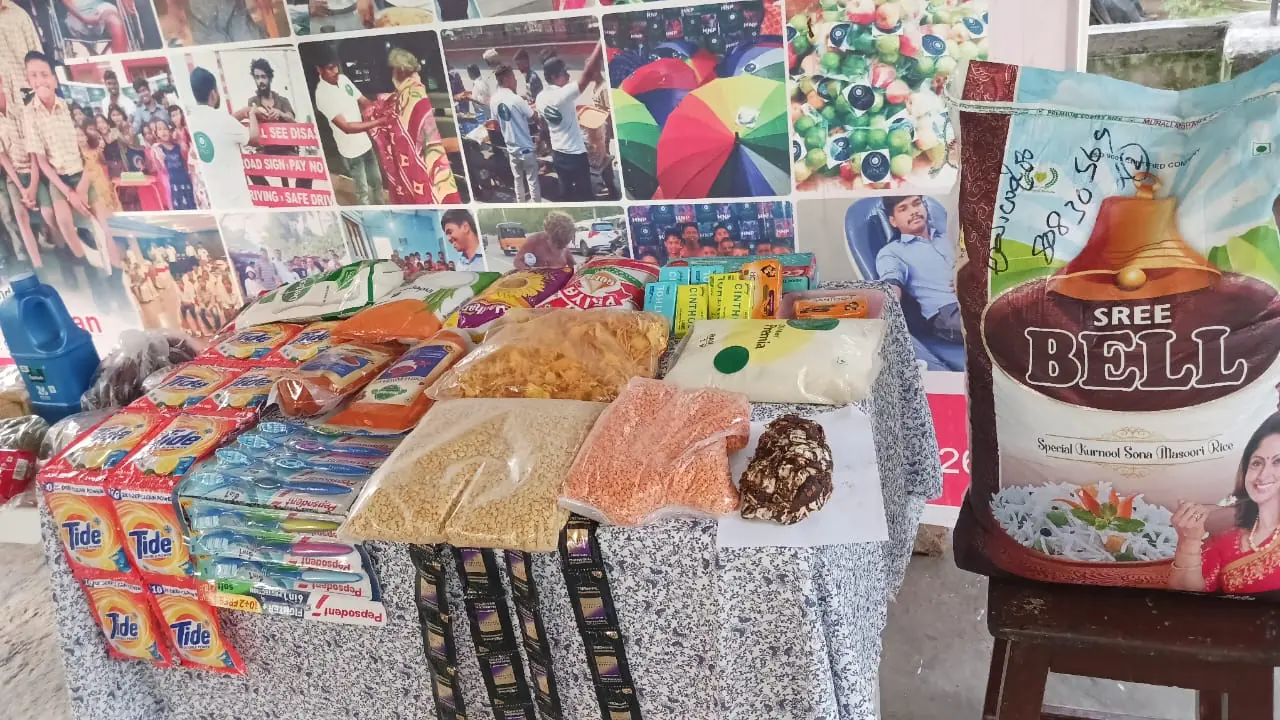
A ration kit typically holds rice, oil, pulses, salt, sugar and tea or milk powder. Where we can, we add eggs, onions, potatoes and soap. We buy in bulk, so every rupee goes further.
A kit is not a long-term solution. We use it to give a family breathing space while we help with work, schooling or health.
Wheelchairs and aids
A wheelchair gives a person freedom. A man who could not leave his home can go to the market, to a clinic or to a relative’s house. A child in a wheelchair can go to school.
We give wheelchairs that donors provide and choose the model with care. We also help to find other aids, such as walking sticks and crutches, where needed.
Looking beyond the gift
After a visit we ask what else the family needs. A child may need books. A woman may need a skill. A man may need a doctor. We connect families to the programs of the trust and to other offices.
We also try to see whether the family has all the papers it needs for schemes: ration card, disability certificate, pension.
How to refer a family
Tell us the name, the address or landmark, the number of people and the main problem. Say whether the family knows that you are contacting us. A volunteer will visit and decide what help is possible.
If the need is urgent, call the trust number and say so.
Living with a disability
A person with a disability faces barriers at home, at school and at work. A wheelchair is a tool, but it also needs ramps, clear paths and kind neighbours. Many people with disabilities stay at home because the world outside is hard to enter.
Our work helps with the first step: the aid. We try also to talk to families about the next step: school, work and community life.


Papers that matter
A disability certificate opens the door to pensions, concessions and schemes. A ration card gives subsidised rice. A bank account receives money directly. A school certificate allows a child to move to the next class.
Volunteers can help families to find the right office and fill the right form. We do not charge for this help.
A family in crisis
A sudden illness, an accident or a death can plunge a family into crisis. The first need is usually food. The next is a way to earn. In between come school fees, rent, medicine and loans.
We help with food, and we look for ways to connect the family to other help. We do not take over the family’s decisions.
Giving to a family without shame
People who receive a kit at the door may feel ashamed. We try to remove the shame by treating the gift as a neighbourly act. We do not hold ceremonies that call attention to the family. We do not take photographs without permission.
If you give to a family, give quietly and kindly, as you would to a friend.
Understanding what a family can do for itself
Most families want to stand on their own feet. Our job is to give them a small push. That may mean a loan guide, a skill course, a school place or a link to a job. We try not to create dependence.
When a family is ready to stand, we step back and cheer.
Staying in touch with families
After a visit, a volunteer calls the family in a week and visits again in a month. We ask what has changed and what is still missing. We update our notes and share news with donors.
If a family moves, we ask them to tell us, so that we can keep in touch.
When a child has a disability
A child with a disability may need a wheelchair, special seating, therapy, a specially trained teacher or simply a school that welcomes her. We help families to find these where we can and we speak up for the child.
The photographs in our records of children in special seats at a home show how much difference a good seat makes.
How it works
A family visit
Hear, see, decide, give.
1
Hear
We listen to the family and neighbours.
2
See
A volunteer sees the home and the people who live there.
3
Decide
We choose what will help most and what the trust can give.
4
Give
A kit, an aid or a link to another service is handed over.
5
Return
We visit again to see how the family is.
Questions
Family support questions
We are here to help, not to judge.
Who can ask for help?
Any family in difficulty in or near Visakhapatnam. A neighbour or a relative can also ask on their behalf.
Is there a fee?
No. Our help is free.
Can I give a wheelchair?
Yes. Clean, working wheelchairs in good repair are welcome. Call us first.
Do you give cash?
We mostly give goods, such as ration kits, and help in kind. In an urgent case we discuss it with the donor.
How long does it take to get help?
We visit as quickly as we can. In an emergency, call and say so.
Do you keep family details private?
Yes. We do not publish names or personal details without permission.
Can I sponsor a ration kit?
Yes. Call us and we will tell you the present cost and send a photograph.
Can you help with a disability certificate?
We can tell you which office to visit and help to fill the form. The decision is made by the government office.
Can I give a walking stick or crutches?
Yes. Clean aids in good condition are useful. Please call first.
Do you visit families outside Visakhapatnam?
Mainly in and around the city. Tell us the place and we will see what is possible.
Refer a family or sponsor a kit
A ration kit or a wheelchair changes a household. Tell us whom to help or sponsor one yourself.
Write to us
Ask about family and disability support
Tell us what you would like to know or do about family and disability support. A volunteer will call you back.
- +91 97036 30893 (call and PhonePe)
- +91 82972 92602 (second number)
- hnpcharitabletrust@gmail.com
- NPS Nilayam, Road No. 2, Gajuwaka S.O., Visakhapatnam, Andhra Pradesh 530026
Write to us
We use your details only to reply to this message. Read the Privacy Policy and the DPDP Act notice.