
Home / Our programs / Creative education
Program 08
Learning that feels like play
Children who enjoy class learn faster and stay in school. Our creative education program uses stories, drawing, games and questions to make learning fun.


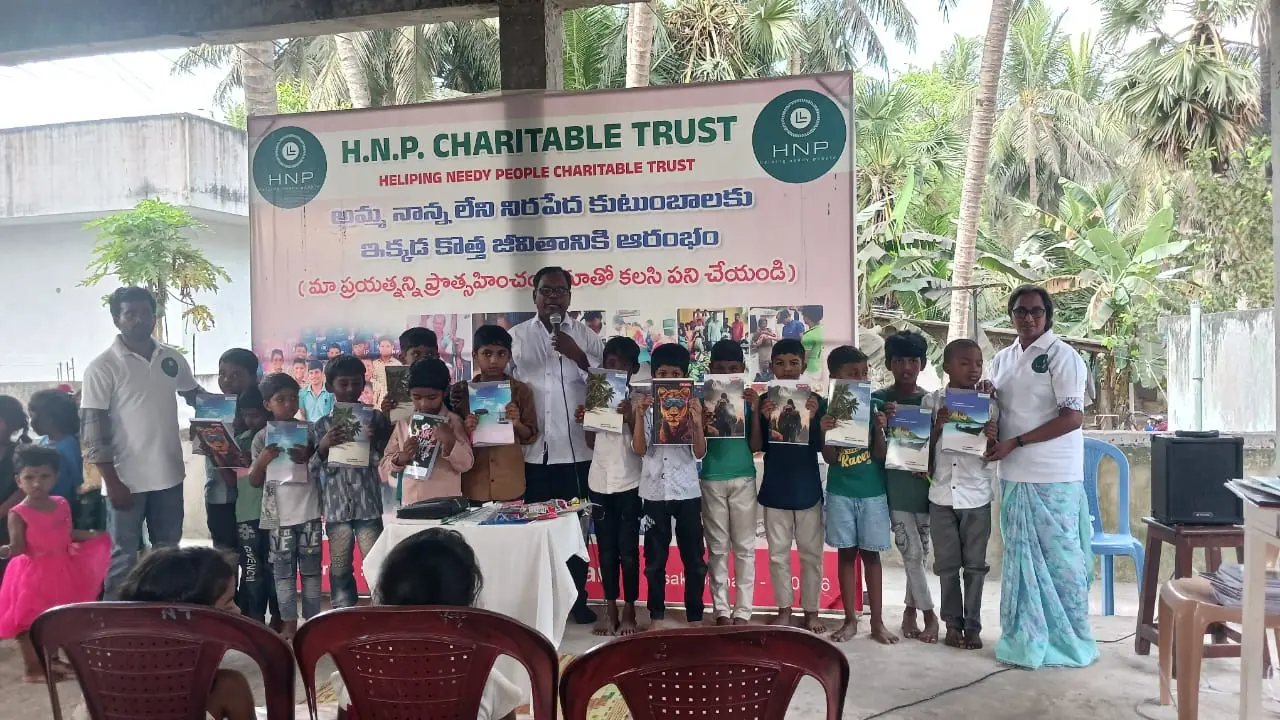
Our setting
A rooftop, a few mats and a volunteer teacher
One photo from our meals programme shows children sitting on a rooftop with their books while a volunteer teaches. There is no blackboard and no desk, but the children are looking at their pages.
The annual report describes creative education as a way for students to use imagination and critical thinking to create new ideas. It is about helping students to find many solutions to a problem, not only one.
It also lists the ways to organise a program: a flexible space, working together, problem-solving methods, and teaching that starts from the learner’s own questions.
A flexible room
The report advises that the physical setting should be flexible. Where children sit and how they face one another affects how they think. We seat children in circles on mats, so that they can see one another and the teacher.
A rooftop, a hall or the veranda of a home will do. What matters is a calm space and a teacher who is not in a hurry.
Working together
Children learn from one another. A shy child may hear an idea from a friend and say it again in her own words. We give small groups a problem and let them argue before we step in.
Group work also teaches patience and sharing, which are lessons that no textbook gives.
Problem-solving
We use puzzles, stories, drawings and simple experiments. A child is asked what would happen if the rain did not come, how a village could save water, or how to share a cake equally among seven children.
The report says to ask open-ended questions that make children comfortable. We do that, and we praise a good question as much as a right answer.
Ideas written down
Children keep a notebook of ideas, drawings and questions. When a child sees her own words on a page, she begins to think of herself as a thinker.
At the end of a session, one or two children present to the group. Nobody is made to speak, but most children want to.
Ten activities for an hour with children
Tell a story and stop in the middle. Ask the children to make up the ending. Give each group a picture and ask what happened just before it. Draw a word and ask children to guess it from the picture. Fill a basket with ten objects, cover it, and ask the children to remember as many as they can.
Ask children to build the tallest tower from paper and tape. Make a map of the neighbourhood on the floor. Count the steps from the classroom to the gate. Sing a rhyme and change a word each time. Let each child bring one question for the group to solve.
Why questions matter more than answers
A child who is only taught to repeat answers will struggle when a test asks something new. A child who is used to asking why will adapt. The report says to ask open-ended questions that make children feel comfortable.
We avoid the words wrong and bad. If an answer is not right, we ask the child to explain how she got there, and often she finds the mistake herself.
The teacher's role
The teacher is a guide, not a judge. She sets the problem, keeps the group on track, and steps in only when children are stuck. A good session has more child talk than teacher talk.
A volunteer who wants to teach with this method needs only a short practice session and a simple plan: an opening game, a problem and a closing activity.
Learning from rooftops and verandas
We have held lessons on a rooftop, on the floor of a children’s home and in a covered hall. None of these places was made for teaching, but all worked because the teacher was ready and the children were curious.
If you have a space that is quiet and safe for an hour, you can host a session. A veranda and a few mats are enough.
How to notice progress without a test
In a creative session, progress shows in small things. A child who did not speak last week raises a hand. A child who copied a drawing now draws her own. A child who gave up on a puzzle now tries a second way.
Volunteers keep a short note after each session: who spoke, who helped a friend, who came up with an unusual idea. These notes help us to plan the next session and to tell a caretaker or a teacher what a child enjoys.
We also ask parents and caretakers what they have noticed at home. A child who comes back from a session with a question for the family is learning, even if the notebook is empty.
How it works
A creative session
About an hour, in four parts.
1
Warm up
A game or a song so that children relax.
2
Problem
The teacher poses a question or a puzzle.
3
Work
Children think, draw or discuss in small groups.
4
Share
A few children explain what they found.
Questions
Creative education questions
Volunteers need patience more than qualifications.
Which ages do you teach?
Mostly children between six and fourteen. We group them by age and by reading level.
Do I need to be a teacher?
No. You need patience and a love of children. We give each new volunteer a plan for the hour.
What materials do you use?
Paper, crayons, chalk, simple blocks, story books and games. We try to use what is cheap and easy to replace.
Do you run it on a fixed day?
Sessions are held when a home or a hall invites us, and when volunteers are available. Ask us for the next date.
Can a school use your method?
Yes. We are glad to share our session plans with any teacher.
How can I sponsor this program?
Give art material, story books or a gift towards a volunteer’s travel and snacks for the children.
What languages do you use?
Telugu and English, depending on the children. Volunteers who speak Hindi are also welcome.
Do you test the children?
We do not give tests. We ask children to explain and show, and we write down what each child enjoyed.
Can parents attend?
Yes. We often invite parents to the last session so that they see what the children made.
How do I become a volunteer teacher?
Fill in the volunteer form and say that you would like to teach. We will give you a short orientation.
What does a first session look like for a child who is shy?
The child sits near the edge of the circle and watches. A volunteer invites her to hold a crayon or a block, never to speak. By the third session most shy children have drawn something and want to show it.
Do you teach children with learning difficulties?
We welcome every child. Volunteers sit beside a child who needs more time, and we ask the caretaker or the family what works best. We are not trained therapists, and we say so, but patience and attention help a great deal.
How do you keep the children safe?
Two adults are present at every session. Volunteers do not take a child out of the room alone, and photographs are taken only with permission. A caretaker or a teacher stays within sight.
Which materials can I donate?
Crayons, coloured paper, chalk, scissors with rounded tips, glue sticks, story books, building blocks, small mats and a notice board are all useful. Please give new or clean items in working order.
Give a child a reason to look forward to class
Crayons, story books and one patient hour a week can change how a child feels about learning.
Write to us
Ask about creative education
Tell us what you would like to know or do about creative education. A volunteer will call you back.
- +91 97036 30893 (call and PhonePe)
- +91 82972 92602 (second number)
- hnpcharitabletrust@gmail.com
- NPS Nilayam, Road No. 2, Gajuwaka S.O., Visakhapatnam, Andhra Pradesh 530026
Write to us
We use your details only to reply to this message. Read the Privacy Policy and the DPDP Act notice.