
Home / Field work / Tribal communities
Field work
Hot lunches carried to the hamlets and served under the trees
Tribal families often live far from towns, markets and clinics. Our volunteers cook, drive and serve hot lunches in the hamlets, so that children and elders eat a proper meal.


Under the tree
Steel containers, plates of rice and a child eating
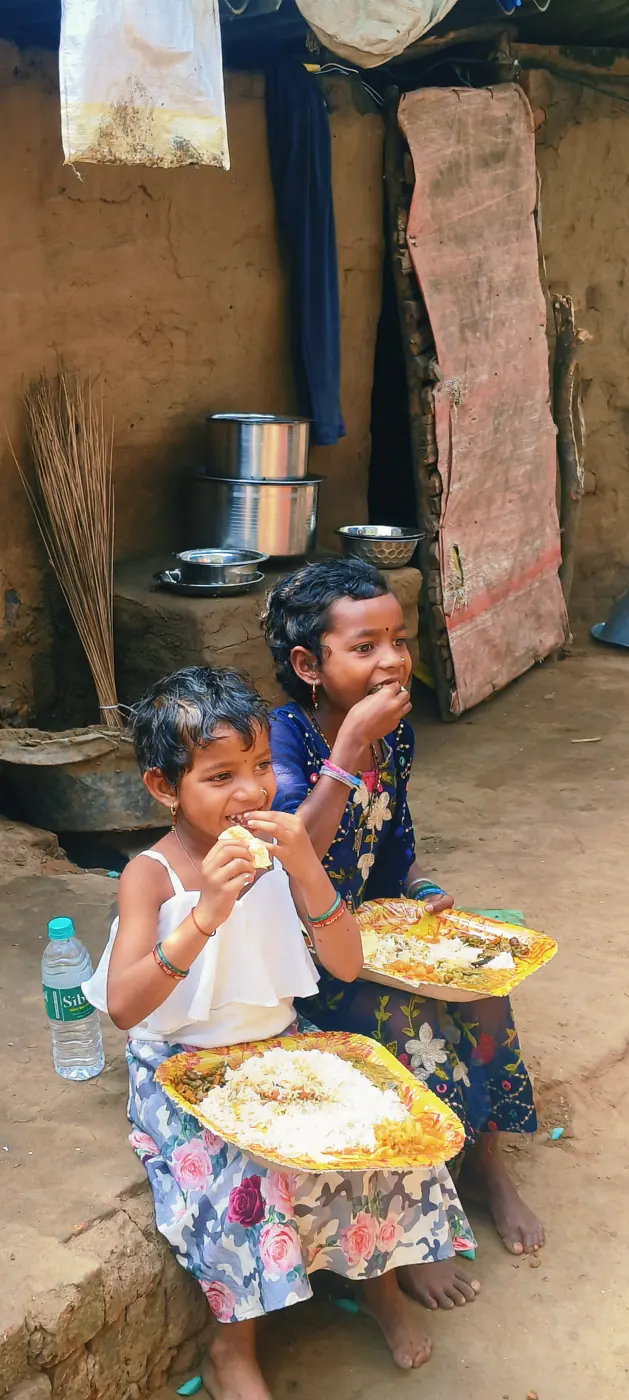
The photographs from our tribal hamlet visits show volunteers beside tall steel containers under a large tree. Villagers wait with plates. A volunteer serves a girl who holds out a plate. A child sits and eats a meal. A woman sits by her brick house with a plate of food in front of her.
The houses in the photographs are made of brick with simple roofs. The ground is bare and dusty. The people are in everyday clothes. The meal is the main event of the day.
The hamlets are far from the town, and the volunteers travel with the food in a vehicle.
Why the hamlets
Families in remote hamlets often depend on farm work or forest produce and have little cash. Access to doctors, schools and shops is limited. Children may miss meals when work is scarce.
A hot lunch is a simple way to say that the people in the hamlet are not forgotten.
How the lunch is organised
Volunteers cook in town or at a nearby place, pack the food in large steel containers and drive to the hamlet. They serve the lunch on arrival, so the food is still hot.
People bring their own plates or the volunteers bring plates. The elders and children are served first. Nobody is turned away.
Listening to the village
Volunteers talk to the people who attend. They ask about children, school, health and water. They look at the houses and the paths. They note what is missing.
A village that is asked what it needs is more likely to tell the truth. We try never to impose a gift that the village did not ask for.
What else we bring
Where we can, we bring blankets, clothes, books or a doctor. We also use the visit to invite people to health camps, and to tell children about school.
We do not go to convert, to canvass or to take photographs for show. We go to serve.
How to help
You can sponsor a lunch, give rice and vegetables, or lend a vehicle for a day. You can join the team as a volunteer. A driver is especially useful.
If you know a hamlet that needs help, tell us the name, the road and the number of families.
The road to the hamlet
Some hamlets are reached by a tarred road and others by a dirt track. In the rains, the track may be impassable. Our volunteers check the route with someone from the hamlet before they set out.
We carry water, a first-aid box and a mobile phone. We tell the hamlet when to expect us.
Food, water and health
The main needs in many hamlets are food, clean drinking water and access to a doctor. A hot lunch meets the first. A water tank, a well or a filter meets the second. A health camp or a visit to a clinic meets the third.
We keep a list of needs that we hear about and share it with donors and with other groups who can help.
Children in the hamlets
Children in remote hamlets may walk long distances to school or may not go at all. We encourage parents to send children to school and offer notebooks and bags where we can.
We also bring story books and a ball. A simple game on the ground with a visitor is a treat.


Respect for local ways
We respect the customs, the language and the leaders of the hamlet. We ask permission to enter, to serve and to take photographs. We do not interfere with local beliefs, and we do not leave rubbish behind.
We believe that people in the hamlets have the right to decide what is good for them.
Planning a lunch for a hundred
A lunch for a hundred people needs about ten to twelve kilograms of raw rice, vegetables, dal and oil, along with firewood or gas, large pans and enough plates. A team of eight volunteers can cook, pack and serve in a morning.
These figures are a guide. The real numbers depend on the day, the village and the food.
After the lunch
When the lunch ends, volunteers clean up and take the containers and rubbish back. They thank the village leader and ask whether the hamlet has any other need. A note is made in the trust’s book.
We also share a photograph with the donor and with the village, if they want it.
Food and nutrition in the hamlets
Many tribal families eat rice with a little dal or greens. Our lunch adds vegetables and, where donors give, eggs or fruit. A balanced plate helps children to grow and elders to stay strong.
We hope one day to bring nutrition talks and growth checks for children along with the meal.
Why photographs are limited here
We take fewer photographs in the hamlets than elsewhere. People may not want to be photographed, and the work is about serving, not showing. The pictures on this page were taken with the consent of those who appear in them.
If you visit with us, please follow the same rule.
A promise to return
A hamlet that is visited once and forgotten feels let down. We try to return and to tell people when. If we cannot, we say so. A promise kept is worth more than a gift.
If you can help us to return more often, with food, a vehicle or time, please call.
Thank you to the hamlets
We thank the people of the hamlets for welcoming our volunteers, for sharing their shade and for teaching us patience. We learn from them as much as we give.
We hope to return soon.
How it works
A hamlet lunch
Plan, cook, drive, serve.
1
Plan
We agree the date with someone from the hamlet.
2
Cook
Food is cooked in large pans.
3
Drive
Containers are carried by vehicle to the hamlet.
4
Serve
The lunch is served to everyone who comes.
Questions
Tribal hamlet questions
If you know a hamlet in need, tell us.
Which hamlets do you visit?
Our photographs come from hamlets near Visakhapatnam. We do not publish the exact names, to protect people’s privacy.
Do you ask for anything in return?
No. The lunch is a gift.
Can I come along?
Yes. Fill in the volunteer form. Dress simply and bring water.
Do you speak the local language?
We try to include a volunteer who speaks the local language, and we ask villagers to help.
How many people do you serve?
It varies. We serve everyone who comes, and we say honestly how many.
Can I sponsor a lunch?
Yes. Call us and choose a day. We will send you photographs.
Do you run health camps in hamlets?
Our camps have been in neighbourhoods. A hamlet camp needs a doctor and a vehicle. Tell us if you can help.
Do you work with the government?
We do not claim any partnership on this website. We follow the rules of each place we visit.
Can I donate rice for a hamlet lunch?
Yes. Rice, oil and vegetables are always needed. Call us.
Do you bring a doctor?
Not on every visit. If you are a doctor and want to come, tell us.
Sponsor a lunch in a hamlet
One pan of rice and curry feeds many families. Choose a day and we will cook.
Write to us
Ask about tribal communities
Tell us what you would like to know or do about tribal communities. A volunteer will call you back.
- +91 97036 30893 (call and PhonePe)
- +91 82972 92602 (second number)
- hnpcharitabletrust@gmail.com
- NPS Nilayam, Road No. 2, Gajuwaka S.O., Visakhapatnam, Andhra Pradesh 530026
Write to us
We use your details only to reply to this message. Read the Privacy Policy and the DPDP Act notice.